

Artificial intelligence has been on the agenda of almost every organization for years. However, there's a gap that's rarely discussed openly: the distance between a promising pilot project and a production-ready system that scales, complies with regulations, and isn't dependent on three key people staying with the company.
That gap is not usually an algorithm problem. It's an infrastructure problem.
The repeating pattern
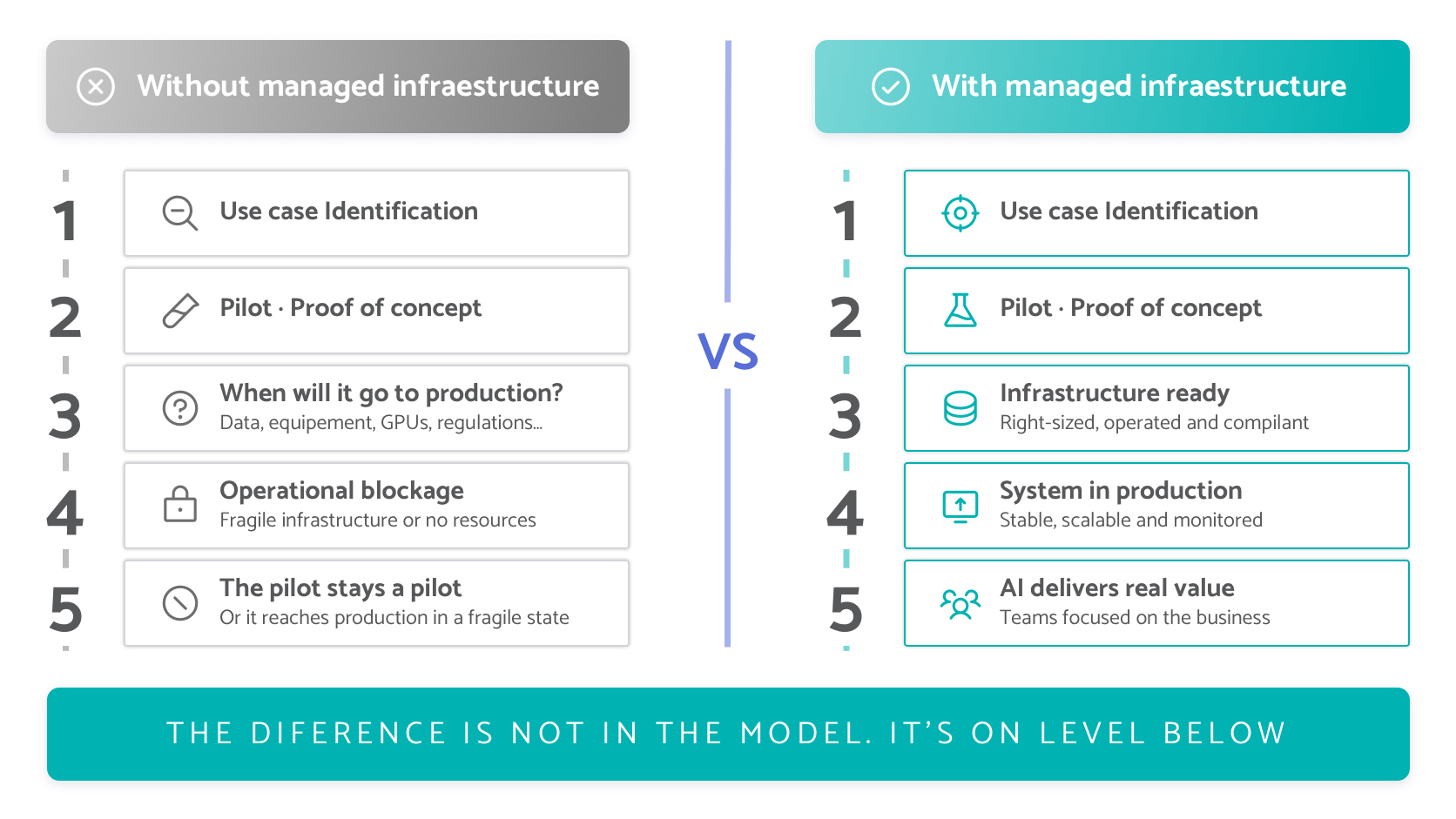
The team identifies a use case with real potential. A test environment is set up, some data is connected, and the model performs well in the demo. There's enthusiasm.
Then comes the business question: when do we put it into production?
And that's where the problem begins.
Where does the data reside? Who manages the environment? How do we guarantee availability?
Do we have sufficient GPU capacity for the actual volume?
Are we compliant with GDPR, NIS2, and industry requirements?
Who handles maintenance when the team that set it up moves on to another project?
The infrastructure built for the proof of concept is not the infrastructure needed for a production system. And setting up that infrastructure—sizing, operating, maintaining, and updating it—consumes time, budget, and talent that most organizations don't have in abundance.
The result: the pilot remains a pilot . Or it reaches production in a fragile state that creates more problems than it solves.
What an AI project really needs to work
A production artificial intelligence system needs much more than a well-trained model.
It needs infrastructure sized for the actual volume of users and data, not for a demo. It needs continuous operation, monitoring, capacity management, and upgrades. It needs availability guarantees when the system ceases to be experimental and becomes business-critical. And it needs to do so within a regulatory framework that is becoming increasingly demanding in Europe.
This doesn't mean that every organization has to become an expert in AI infrastructure. It means that someone has to be.
A different model: infrastructure as a service, not as a project
There is an alternative to the "build and operate in-house" model: outsourcing the AI infrastructure to a specialized partner, while maintaining control over the data and system governance.
This is the same reasoning that led organizations to stop managing their own data centers for business applications. The difference is that here, the European regulatory context—GDPR, NIS2, DORA, ENS—adds a layer of complexity that makes choosing the right partners and data location even more crucial.
A well-structured model allows the organization to:

Start with a platform tailored to your real needs, without oversizing from day one.
Scale capacity as projects evolve and new use cases emerge.
Operate with predictable costs, without budget surprises due to peak demand or upgrade needs.
Ensuring that data remains in European infrastructure, under control and within the regulatory framework.
Free up the internal technical team to focus on AI projects, not platform administration.
The question worth asking
If your organization is developing—or wants to develop—artificial intelligence projects, there is one question that should be answered honestly:
do you have the infrastructure, the team, and the processes necessary to bring those projects into production and keep them running
???
If the answer isn't a clear yes, the problem isn't with the AI model. It's one level deeper.
At Uniway, we work with organizations that want to accelerate their adoption of artificial intelligence without taking on the operational burden of managing the infrastructure. If you're at that point, we can tell you how we do it.
Want to know more?


